
Keep Watch
Advent I

“Therefore keep watch, because you do not know on what day your Lord will come.” Matthew 24:42
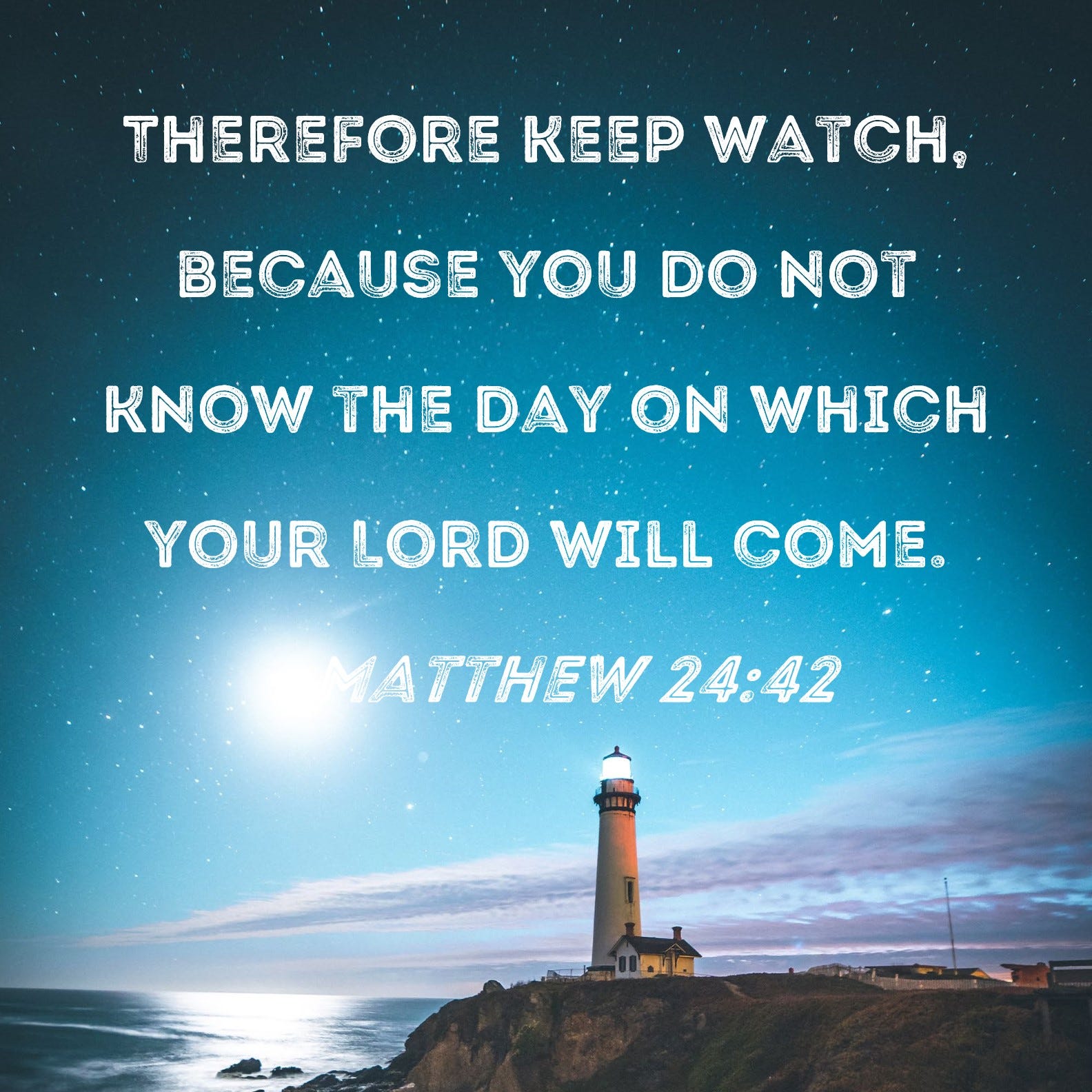
I had one job to do: keep watch.1
I was tasked with manning the front desk of an office building in downtown Chicago from 9 pm to midnight. My boss just needed a warm body to be there in case someone walked in, and I was warm enough. The only problem was that I couldn’t stay awake. The boredom of sitting at that large wooden desk in that stale lobby lulled me to sleep. I tried to stay awake. I read books and watch TV shows, but it didn’t work. Sure enough, before the clock struck midnight, I was out cold.
Keeping watch is easier said than done.
Jesus knew this as he addressed his disciples in Matthew 24. In his absence, Jesus’ disciples had one job: keep watch. As they awaited his return, they were called to live with purpose and love, but Jesus warns them that waiting faithfully doesn’t come naturally to humans.
Jesus says to his disciples, imagine a servant whose master leaves him in charge of his household while he goes away on business. A good servant is not concerned about when his master will return, because he is focused on doing the good work his master gave him to do. Whereas a wicked servant becomes complacent in his work, assuming his master will not return today or tomorrow, so he can delegate his responsibilities to the other servants and spend his free time with his buddies at the dive bar. When the other servants don’t do as he says, he lets out his anger by beating them to a pulp. Of course, the master eventually does return, surprising the wicked servant, and the servant is severely punished.2
Jesus’ point seems plain: as you wait, will you be the good servant or the wicked servant?
Keeping watch for Christ’s return by living with purpose and love is an incredible calling, but it’s also demanding. It is so demanding that humans tend to cave under the task. Instead of using our time for the good work God gives us, we turn inward, living meaningless lives in which banal pleasures are our supreme joy, and people are commodities to be used and exploited.
In Neal Shusterman’s novel, Scythe, he tells the futuristic story of a world where death has been defeated. However, humans don’t respond to this eternal life in ways you’d expect. Instead of using their time advantageously: learning languages, developing a broad range of skills, and experiencing life to the fullest, they seem to have become numb to the vast possibilities of human life. At one point, a character reflects,
“I wonder what life will be like a millennium from now, when the average age will be nearer to one thousand. Will we all be renaissance children, skilled at every art and science, because we’ve had time to master them? Or will boredom and slavish routine plague us even more than it does today, giving us less of a reason to live limitless lives? I dream of the former, but I suspect the latter.”
There is something about the human condition that, when given wide-ranging freedom to live good and full lives, we curve in on ourselves instead.
We get impatient, bored, and hopeless. Jesus told us to wait, but for how long? It’s been two thousand years already. What are we supposed to even do with our time? We go to church, we try to be good people, but he still doesn’t show up. Maybe he’s not coming back. Maybe we’ve all been hoodwinked. When impatience, boredom, and hopelessness become our postures, then it’s not long before we become a lot like the wicked servant in Jesus’ parable.
The Good Servant is Jesus
The truth is, when I was tasked with keeping watch over that office building in Chicago, there were some nights when I made it to midnight without falling asleep. I didn’t fail every time. Likewise, as Christians, there are times in our lives when we faithfully await Christ’s return by living with purpose and love.
However, we must admit that we’re hardly consistent in our waiting. Which is why I think it is a misreading of Matthew 24 to assume Jesus is giving us a pep talk like a coach at halftime. Jesus doesn’t warn us about the wicked servant so that we get our acts together and become like the good servant. He warns us about the wicked servant, so that we will see that the only good servant is Jesus Christ.
Jesus faithfully keeps watch on our behalf. He is our high priest who is interceding for us before the Father. He gives his full attention to the needs of his people and prays for us without ceasing. He never chooses banal pleasures over us; instead, he always puts his love for us first.
During this Advent Season, we remember Christ’s incarnation. He became like us in every way, and we learn from this passage that he even became like us in our unknowing. He does not know the day or hour when the Father will send him back to make all things new, but in the meantime, he is keeping watch.
As members of the body of Christ, God calls us to keep watch for the return of Christ with the full assurance that Jesus keeps watch for us. Instead of reading Matthew 24 and responding with a “stay busy for Jesus” attitude, we can confess our inability to keep watch and our desperate need for God to step in and do the watching for us.
Advent begins with a confession: we’ve been given a job to do, and we can’t do it.
Advent concludes with a birth: we can’t do our job, but the Christ child will.
This post is based on a sermon I preached at Palo Alto Christian Reformed Church on 11/30/25. Listen to the full sermon here: https://www.pacrc.org/listen-online
Read Matthew 24:45-51 for the full story.
Great conclusion! :-)