
Why Loving Your Enemies Feels Wrong
Holding the Light When It Hurts

The picture below is an artwork entitled “Festival of Lights” by John August Swanson.
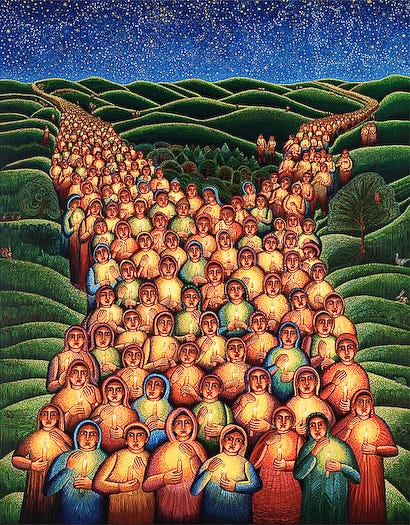
In the description of his painting, he says this:
I thought about liturgical processions I had seen. I remembered walking with groups in candlelight for peace in Central America. The symbol of candles shining in the dark night is powerful to me. …My original thought was that this would be a procession of children from every city and town. The children would bring light and peace to the world. They would gather from many places, joining an unending procession towards peace and nonviolence for all children of the world.
In his painting, John Swanson showcases what it looks like for a group of people to bring light into the pervasive darkness.
It is an image that Jesus was also trying to paint for the people he was preaching to here in Matthew 5:
An image of all of us, gathered together processing towards the dark and hurting world with the love and light of Christ shining brightly from our candles.
We can imagine through Jesus’ words and this image being these people.
And it sounds lovely and inspiring and something we can get behind.
But then later in his sermon, Jesus surprises us with his call to do something that we didn’t see coming.
What is the actual light-bringing and salt-giving that we are called to do?
How are we supposed to do this?
Jesus says: Love your enemies. And Pray for those who persecute you.
Last week, Travis told us that “In order to love, we must be vulnerable enough to be loved.”
I might add then: In order to love, we must be vulnerable enough to be loved and to be hurt.
See, in this passage, Jesus reminds us that we do not get a reward for loving those who love us. There’s no gold medal prize waiting. It’s easy–it’s expected. It’s what everyone else is doing.
“Nobody’s gonna give you a medal!”
These disciples listening to Jesus were probably excited to get on board with this loving the world when it involved loving children.
Or loving their friends.
Or loving their neighbors.
Or loving those who are easy to love.
But the love Jesus is calling us to actually is physically and emotionally painful: You must love those who hate you.
You must love your enemies.
And pray for those who persecute you.
See, Jesus is continuing to clarify the gospel message.
N.T Wright says this about this call of Jesus:
Israel isn’t chosen in order to be God’s special people while the rest of the world remains in outer darkness.
Israel is chosen to be the light of the world, the salt of the earth.
Israel is chosen so that, through Israel, God can bless all people.
And now Jesus is calling Israel to be the light of the world at last.
He is opening the way, carving a path through the jungle towards that vocation, urging his followers to come with him on the dangerous road.
Being the people of God who share the light of Christ to the world is dangerous.
Sharing the light of Christ demands a sort of vulnerability that might lead you to be hurt.
Israel lived in divisive times much like ours.
N.T. Wright says that for Israel, there was constant fear of the Roman Authorities, fear of dissension within, corruption within their religious communities, movements of national resistance rising up, and anger over injustice and wickedness.
For us, we also have a country who has expressed fear of American authorities, fear of dissension within our communities, corruption within our religious communities, movements of national resistance rising up all over the country, and anger over injustice and wickedness.
And in both of these contexts, you have people hurling rhetoric towards the other side like grenades.
How do we enter into this mess and confusion and hatred and bring the light of Christ to our warring world?
It might involve walking into the war zone with your light held high and facing the vulnerable risk of being hit and wounded.
I wonder if this text in Matthew brings up dissonance for you as you think about our cultural moment in America?
Perhaps you do feel the sway of one political party or another in their rhetoric right now about immigration, law enforcement, democracy, authoritarianism, and fear.
Perhaps the media you consume has pegged one enemy that you see as the problem in our society right now and your heart feels influenced.
So, Maybe we can stop to consider for a moment:
Who do you think is your enemy?
Who comes to mind?
Now, what would it feel like to love this enemy and pray for them?
Not to pray that they would change, or that they would get their act together.
Not to pray that they would stop being evil nor that they become better people.
Or that they would be defeated or humiliated.
While we have plenty of space in our scriptures to lament, seek justice, express our anger, pray for their tyranny to end, and fight for the oppressed, this command of Jesus in this passage is very different.
He’s saying:
What would it look like to pray for your enemies as if you really loved them?
As if they were your friend?
EXERCISE: PRAY FOR YOUR ENEMIES
What would it feel like to pray this prayer over your enemy?
I want you to sit and listen to this prayer and reflect about what you feel as I pray these words:
Almighty Father, we lift up our enemies.
We pray for your mercy to be present to our enemies.
Lord, be as a honeycomb to our enemies.
Almighty Father, be to our enemies as the voice of angels laughing in the heavens.
Jesus, be to our enemies as the smiling face of God.
Almighty Father, be to our enemies as the day is to the soul of the fearful child.
Be to our enemies as the light is in the night of despair.
Almighty Father, be to our enemies as the love of a Christian for the Church of God.
Bring them into your Love, Lord Jesus.
In the name of Jesus, your Son, we pray. Amen.
As you read this prayer, what did you feel?
If you’re human like me, you probably felt some deep dissonance about this one.
It doesn’t feel right to pray for these things.
You might be feeling frustration or repulsion by such a prayer:
I want to pray for justice.
I want to pray for them to change.
I want to fight.
I want to protest to God.
I want to pray for God to smite them down and end their cruelty.
I want to pray that God would take up the needs of the oppressed, not their needs.
Me, too.
In praying for our enemies, though, what we must remember is that we are not calling their actions good.
Or that what they are doing doesn’t matter.
It does matter.
And it matters to God.
But here, in Matthew 5, Jesus commands us to love our enemies and pray for those who persecute us.
Why?
Because we are to be imitators of Jesus Christ, who loved his enemies first.
GOOD NEWS
See, the Sermon on the Mount can feel like a long list of to-do’s and rules that as we read through we feel bogged down by the mandates.
“Ugh. I tried to follow this command and failed again.”
“There’s too many. I can’t do it!”
But that’s the point of the Sermon on the Mount.
We cannot do it on our own!
N.T. Wright reflects on the purpose of this text, saying:
But again Jesus’ teaching isn’t just good advice, it’s good news.
Jesus did it all himself, and opened up the new way of being human so that all who follow him can discover it.
When they mocked him, he didn’t respond.
When they challenged him, he told quizzical, sometimes humorous, stories that forced them to think differently.
When they struck him, he took the pain.
When they put the worst bit of Roman equipment on his back—the heavy cross-piece on which he would be killed—he carried it out of the city to the place of his own execution.
When they nailed him to the cross, he prayed for them.
The Sermon on the Mount isn’t just about us.
If it was, we might admire it as a fine bit of idealism, but we’d then return to our normal lives.
It’s about Jesus himself.
This was the blueprint for his own life.
He asks nothing of his followers that he hasn’t faced himself...The Sermon on the Mount isn’t just about how to behave.
It’s about discovering the living God in the loving, and dying, Jesus, and learning to reflect that love ourselves into the world that needs it so badly.”
The Gospel of Jesus Christ is about Jesus himself taking the candle into our war zone and walking into our dark and hateful world and shining the light on us, risking EVERYTHING—living out a vulnerability that is terrifying, and asking us to follow him so that we may also walk with him in the light.
The Gospel of Jesus Christ is about Jesus himself fulfilling the law perfectly.
The Gospel of Jesus Christ is about Jesus himself fulfilling the commands here in the Sermon on the Mount Perfectly.
The Gospel of Jesus Christ is about Jesus loving his enemies perfectly.
Because if he hadn’t, we, His adopted people, would never be wrapped up into the love of the Trinity through Jesus Christ.
He loved his enemies—desiring that they would come to know him.
Desiring that they would know the Father’s love smiling on them even when they persecuted him.
He prayed for them: Father, Forgive them, for they know not what they are doing.
And he calls us to come, follow him to do the same.
And behind him follows a giant crowd of people who answered his call and started carrying their light with Jesus as their head, bravely walking into a warring world of darkness because Christ was journeying with them.
They heeded his call to be a light in the world by loving our enemies and praying for those who persecute us.
To be the salt of the earth that infuses this toxic and warring world with the seasoning of the gospel of radical love.
The scholar Stevan Eason wonders if maybe this is what it means in Galatians 2 when Paul wrote “It is not longer I who live, but it is Christ who lives in me.”
He says, “No one can produce a Christlike life by sheer will or disciple. How else could the folks in the pew–the banker, the teacher, the lawyer, the business person, the contractor, the teenager, the alcoholic, or anybody else do this? There is no way. Christ has to do it in us.”
CONCLUSION
The Holy Spirit is empowering all of us—ALL of us, to show the light of Christ to this hurting and hurtful world by extending the love of Christ to those who least deserve it.
In doing so, we are bringing light to the darkness.
We are not blending into the rhetoric of hate and fear.
We are bringing Christ’s dominion of peace to a world so enraptured by war.
May we, people of God, receive the empowerment of the Holy Spirit and choose today to raise the light of Christ above our heads and walk into our world to love our enemies and pray for those who persecute us.
CLOSING PRAYER
Let us do so now:
Father,
We pray for our enemies.
We need help praying for our enemies.
We pray that they would know the profound love of God in Jesus Christ.
We pray that our enemies would feel the nurturance and care of Christ right at this moment.
May they have family members and friends reach out to them in love and peace.
May they be financially provided for.
May you hear their prayers and respond to their needs.
May you show them your light, Jesus Christ, and bring them to yourself.
Help us, Jesus, to follow you in this path of loving our enemies.
Help us pray: Father, Forgive them, for they know not what they do.
In the name of the Father, the Son, and the Holy Spirit. Amen.
 | A guest post by
|